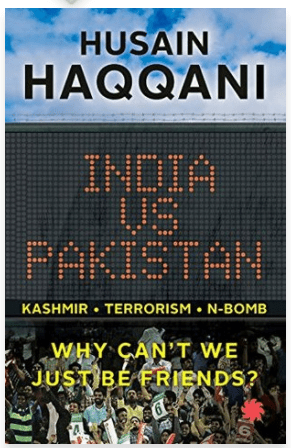
I read this book back in 2018 to get an idea about how a Pakistani might feel about his country’s relationship with India. Hussain Haqqani, the author, is a former Pakistani diplomat and journalist who held important positions such as advisor to Nawaz Sharif, Ambassador to the United States, etc., and thus has the advantage of an insider to the establishment.
The book begins its first chapter detailing the important challenges facing the nascent Islamic Republic. It starts with mentioning the contribution of Jinnah towards the formation of Pakistan and his conversation with the American Ambassador regarding his intent to establish friendly relations with India, resembling the US-Canada relations.
However, the author goes on to admit that India-Pakistan friendship as envisioned by Gandhiji or Jinnah might be near impossible today after decades of continuous conflicts. Even though he candidly admits that this is complicated by ‘Pakistan’s near pathological obsession with India’, he quickly adds that India’s early leaders like Nehru and Patel did nothing to reassure their neighbor. He also blames the Congress party (he cites the party’s resolutions) for harbouring dangerous beliefs that both countries may become united once again, thus denying the legitimacy of separate Pakistani nationhood.
The rest of the chapter describes the compulsions during post-independence that complicated the India-Pakistan relations. It refers to early Pakistani politicians and their rhetoric. Many of who migrated from India, such as Liaquat Ali from Haryana and others, attempted to create an ideological Pakistan with which they could also associate better. They constantly emphasized the ‘two-nation theory’ and notion of an eternal conflict between Hindus and Muslims, these being easy diversions from questions about their status as ‘sons of the soil’.
The chapter also touches on the Pakistani military’s role in the polity since its inception. From the coup of General Ayub Khan to Bhutto’s assassination the reader is presented with a brief evolution of the country as a ‘national security state’.
The second chapter dwells on the issue of Kashmir and its genesis. In fact, it is one of the most comprehensive accounts of this intensely contested issue that I have come across so far, narrated somewhat sensibly through the lens of someone from across the border. He describes how the Pakistani government insists on keeping the issue burning through overt and covert methods. India’s calls for normalizing relations especially during the Manmohan era were constantly dismissed by Pakistan, which instead wanted a settlement of the Kashmir dispute before engaging in any ‘friendship’.
The third chapter is about the Pakistani nuclear program. It provides interesting anecdotes that throw light on the current thinking in the establishment on the matter. Pakistan’s nuclear program has been always about the ‘Indian threat’ and it remains so to this day. Probably because a lot of information was very new to me, I found this chapter to be the most interesting one.
The next chapter deals with the issue of cross-border terrorism which is the biggest thorn in the India-Pakistan relations. Interestingly, the chapter also provides interesting anecdotes whereby both countries worked together such as during 2016 when Pakistan provided intelligence on an impending attack on Somnath Temple thereby averting a disaster, and when R&AW provided intelligence on an attempt on President General Pervez Musharraf’s life back in 2003. The rest of the chapter is however about the general lack of trustworthiness within the Pakistani establishment and the reasons thereof that abet the state-sponsored terrorism against India.
And in the last chapter, the author strongly argues the need for resolving differences and warns that the space for such a rapprochement is shrinking, due to reasons including the rising wave of ultra-nationalism in India. He notes that Pakistan’s nationalism which has been, since its birth, based on the idea of anti-Indian sentiments needs to be fixed too.
Overall, the book is a very lucid read and has given me a lot of insights into the India-Pakistan relations, especially from a liberal Pakistani’s point of view. The author ignores a few important areas such as the role of cold war politics, especially the US actions, in aggravating the relations of both countries. Some of the events described can perhaps be interpreted in alternate ways too. However despite its flaws, this book can challenge your biases and also widen your horizon, as it has done to me.
 Mahesh MS